Private Jet Cost: How Much Does It Cost to Fly Private?
Flying private costs far more than most people expect, and far less than many assume. How much does it cost to fly private? The honest answer ranges from around $2,000 to over $14,000 per flight hour for private jets, with VIP airliners higher still, depending on aircraft size, route, and onboard services. A short domestic trip on a light jet might total $10,000. A transatlantic flight on a heavy jet can exceed $150,000. This guide breaks down exactly what drives private jet charter costs, which fees catch first-time flyers off guard, and where genuine savings exist, from empty leg flights to membership programs. Whether pricing a single charter or evaluating a fractional ownership program, the figures and frameworks below give a clear, complete picture of what flying private actually costs today.
What Does It Cost to Fly Private? (Quick Reference)
Flying private costs between $2,000 and $14,000 or more per flight hour, depending on the aircraft category, route, and operator. The table below covers every major aircraft tier so you can quickly benchmark what a private jet flight will cost before factoring in additional fees.
| Aircraft Category | Typical Hourly Rate | Passenger Capacity | Best For |
|---|---|---|---|
| Turboprop | $1,800 to $2,500 | 4 to 9 passengers | Short regional hops, smaller airports |
| Very Light Jet (VLJ) | $2,000 to $3,000 | 2 to 5 passengers | Short trips under 2 hours |
| Light Jet | $2,600 to $3,500 | 4 to 8 passengers | Short domestic trips up to 3 hours |
| Midsize Jet | $3,500 to $5,500 | 7 to 9 passengers | Cross-country or medium-range routes |
| Super Midsize Jet | $5,000 to $8,000 | 8 to 10 passengers | Transcontinental and transatlantic routes |
| Heavy Jet | $8,000 to $13,000 | 10 to 16 passengers | Long-haul and international flights |
| Long-Range Jet | $10,000 to $14,000+ | 10 to 19 passengers | Ultra-long routes such as New York to Dubai |
| VIP Airliner | $14,000 to $25,000+ | 19 to 100 passengers | Large groups, heads of state, corporate delegations |
Rates reflect current US charter market data across operators and broker platforms.
Most charter operators require a minimum booking of two flight hours, which means the price to hire a private jet starts at roughly $4,000 to $7,000 even for a short trip. That floor matters when comparing the cost of flying private against first-class commercial tickets.
The hourly rate is only one part of what you will pay. Total trip cost includes aircraft positioning fees, fuel surcharges, landing fees, crew expenses, and applicable taxes, all of which can add 20 to 40% on top of the base rate. The sections below break each of those costs down individually so you can build an accurate budget before booking a charter flight.
Understanding how much it costs to fly privately starts with knowing which aircraft category fits your route and passenger count. Choosing a light jet for a two-passenger, 90-minute flight looks very different on the final invoice than booking a heavy jet for a transatlantic crossing with 12 passengers.
How Are Private Jet Charter Prices Calculated?
Calculating private jet charter prices is more complex than applying a flat hourly rate. Several variables interact to determine what passengers actually pay, and understanding them is the difference between getting a fair quote and overpaying.
Billable Flight Time vs Block Time
Charter operators bill for flight time, not the total time a passenger spends traveling. Billable flight time starts when the aircraft engines spool up and ends at the destination. Block time, the broader window that includes taxi, ramp holds, and ATC delays, is absorbed differently by different operators. Most FAR Part 135 operators bill from wheels-up to wheels-down on the chartered segment, but passengers should confirm this in writing before booking. Established, reputable operators publish transparent billing policies, which makes comparing quotes significantly easier.
A minimum flight time charge also applies on most routes. An operator flying a one-hour leg will typically bill for 1.0 to 1.5 hours minimum, regardless of actual airborne time.
Aircraft Positioning and Repositioning Fees
When an aircraft is not already based at the departure airport, it must fly to the passenger empty. This deadhead repositioning leg is billed to the charter client, either as a flat fee or at the standard hourly rate for the positioning segment. On a New York route originating at Teterboro (TEB), for example, if the aircraft is based at an airport two hours away, expect to pay for that two-hour ferry flight.
Operators holding an Air Carrier Certificate under Federal Aviation Administration (FAA) regulations, required under FAR Part 135, must log and account for all flight segments. This regulatory framework ensures safety compliance but also makes repositioning costs a documented, unavoidable line item on most quotes.
Peak Demand and Seasonal Pricing
Private jet charter prices surge during high-demand periods. Thanksgiving, Christmas, New Year's, the Cannes Film Festival, and major sporting events all compress aircraft availability and drive rates up 20 to 40% above baseline. Holiday travel out of airports like Teterboro, HPN, and JFK routinely sees availability tighten 6 to 8 weeks in advance. Booking early or locking in a membership program rate protects against seasonal cost spikes.
Private Jet Rental Cost by Aircraft Type
Private jet rental cost varies more than most travelers expect, and the aircraft category drives the biggest share of that difference. The tiers below cover every level of the market, from turboprops to VIP airliners, with hourly rates, cabin specs, and sample routes so you can estimate what a specific trip will actually cost.
Turboprops and Very Light Jets (VLJs)
Turboprops and VLJs represent the most affordable entry point into private aviation. Hourly rates run $1,800 to $2,500, with turboprops like the Pilatus PC-12 carrying up to 9 passengers and VLJs like the Embraer Phenom 100 seating 4. Cabins are compact, stand-up height is generally not possible, and range tops out around 1,200 to 1,500 nautical miles.
These aircraft fit short regional hops: New York to Boston, Dallas to Houston, or Los Angeles to Las Vegas. For a 2-hour private flight on a turboprop, total charter cost typically falls between $2,500 and $5,000 before fees. For non-jet options in this category, our plane rental cost guide breaks down piston and turboprop pricing in more detail.
Light Jets
Light jets are the most popular charter category for domestic trips under three hours. Hourly rates range from $2,600 to $3,500, with aircraft like the Citation CJ3+ and Learjet 75 Liberty seating 6 to 8 passengers. Range extends to roughly 1,500 to 2,000 nautical miles, making routes like New York to Miami or New York to Chicago straightforward non-stop flights.
A 3-hour private flight on a light jet costs approximately $8,000 to $12,000 in base charter fees. A 1-hour private flight on the same aircraft runs $3,000 to $4,500 depending on the operator and departure airport.
Midsize and Super Midsize Jets
Midsize jets, including the Hawker 800XP and Citation XLS, seat 8 to 10 passengers and cruise over 2,500 nautical miles, handling routes like New York to Los Angeles or Dallas to Toronto non-stop. Hourly rates run $3,500 to $5,500.
Super midsize jets like the Challenger 350 and Citation Longitude step up cabin stand-up height to approximately 5 feet 11 inches, extend range to 3,500 nautical miles, and command $5,500 to $7,500 per hour. A 5-hour private jet charter on a super midsize aircraft, enough to cover New York to Los Angeles with room for headwinds, costs roughly $28,000 to $40,000.
Heavy and Long-Range Jets
Heavy jets such as the Gulfstream G450, Challenger 605, and Global 5000 carry 10 to 16 passengers in full stand-up cabins and reach 4,500 to 6,500 nautical miles. Hourly rates span $8,000 to $13,000. A 4-hour private jet flight from New York to Miami on a heavy jet can exceed $40,000 when positioning and fees are included, though that cost is typically split across larger groups. For model-level detail, see our Gulfstream charter cost guide.
Long-range jets like the Gulfstream G700 and Global 7500 open up non-stop routes from New York to London, Dubai, or Tokyo. Per-trip costs on a transatlantic route from New York to London routinely reach $150,000 or more when accounting for crew, fuel, landing fees at airports like Teterboro or Heathrow, and overnight costs. Routes from Los Angeles to Hong Kong push costs higher still.
VIP Airliners (BBJ and ACJ)
At the top of the market sit VIP airliners: the Boeing Business Jet (BBJ), Airbus Corporate Jet (ACJ), and Embraer Lineage 1000. These aircraft carry 30 to 50 or more passengers in custom-configured cabins that can include bedrooms, conference rooms, and shower suites. Hourly charter rates start at $15,000 and regularly exceed $25,000.
Ultra-long-haul routes, New York to Dubai, Los Angeles to Tokyo, London to Hong Kong, are where VIP airliners make commercial sense for large delegations or high-net-worth groups. Charter costs for a single intercontinental trip on a BBJ or ACJ frequently surpass $500,000. Few competitors publish pricing at this tier, but specialist operators and brokers can source and price these aircraft on request.
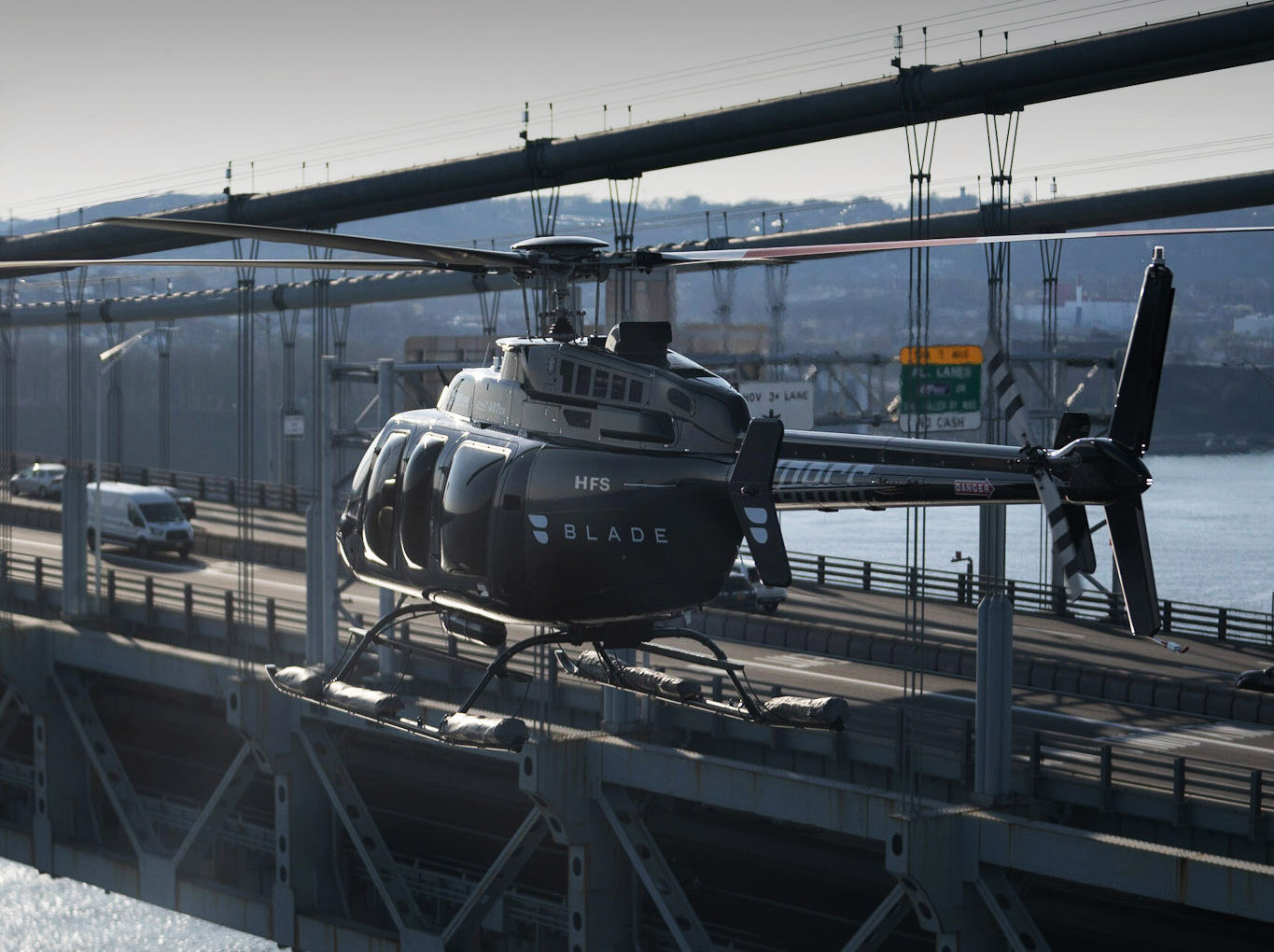
Did you know that you can get from Manhattan to JFK in under 5 minutes without driving?
Blade offers seamless helicopter transfers from our West 30th Street Lounge in Manhattan to JFK Airport in just 5 minutes from $195 per seat.
Skip the traffic and ditch the stress with Blade's year-round airport service.
What Is the Average Cost of a Charter Flight?
The average cost to charter a private jet in the United States falls between $5,000 and $10,000 for a typical 2-hour domestic flight on a midsize jet. That figure includes the base hourly rate, fuel surcharges, landing fees, and crew costs, but the total shifts significantly based on route, aircraft category, and operator. A transcontinental trip like New York to Los Angeles on a heavy jet can run $50,000 or more once all fees are factored in.
The table below shows realistic all-in estimates across three common flight durations:
| Trip Duration | Aircraft Type | Estimated Total Cost |
|---|---|---|
| 2 hours (e.g., New York to Miami) | Midsize jet | $8,000 to $14,000 |
| 3 hours (e.g., New York to Chicago) | Midsize to heavy jet | $15,000 to $28,000 |
| 4 to 5 hours (e.g., New York to Los Angeles) | Heavy or ultra-long-range jet | $40,000 to $65,000 |
These ranges account for repositioning fees, which apply when the aircraft must travel empty to reach your departure airport before the trip begins. On busy routes and peak travel dates, those costs rise further.
New York-area travelers have four primary private terminal options, and the choice affects both convenience and price. Teterboro Airport (TEB) in New Jersey is the most active private aviation gateway in the Northeast and serves as a hub for major charter operators. Westchester County Airport (HPN) in White Plains suits passengers traveling from the northern suburbs. Republic Airport (FRG) on Long Island is a strong option for eastern Long Island and Hamptons-bound traffic. Long Island MacArthur Airport (ISP) in Ronkonkoma provides a quieter, lower-fee alternative for Suffolk County departures.
For passengers asking how much it costs to fly privately from New York on a short regional hop, say, to Boston or Philadelphia, a light jet charter typically runs $4,000 to $7,000 all-in for a one-way trip. That price point reflects the shorter billable flight time and lower positioning costs associated with smaller aircraft operating out of regional airports like HPN or FRG.
Did you know you can get from Manhattan to JFK in under 5 minutes without driving? Blade offers seamless helicopter transfers from our West 30th Street Lounge in Manhattan to JFK Airport in just 5 minutes, from $195 per seat. Skip the traffic and ditch the stress with Blade's year-round airport service.
What Additional Fees Apply to a Private Jet Charter?
Chartering a private jet involves more than the base hourly rate. Several mandatory and optional fees add to the total cost, and understanding each one prevents surprises on the final invoice.
Federal Excise Tax and Segment Fees
The IRS applies a 7.5% Federal Excise Tax (FET) to all domestic charter flights booked under FAR Part 135, the Federal Aviation Regulation framework governing commercial air charter operations. In addition to the percentage-based tax, a per-segment fee applies, set at about $5 per segment and adjusted annually for inflation. A segment counts as each individual takeoff-to-landing leg. On a round trip with two segments, both the percentage tax and the per-segment fee apply twice. These charges are non-negotiable and appear on every domestic invoice regardless of operator.
Landing, Ramp, and Handling Fees
Airports charge landing fees based on aircraft weight and facility type. At major commercial airports like JFK, these fees run higher than at reliever airports such as Teterboro (TEB) or Westchester County Airport (HPN), one reason operators and clients favor those alternatives for New York-area flights. Fixed Base Operators (FBOs) add ramp and handling fees that typically range from $150 to $500 per visit, covering ground crew services, aircraft marshaling, and terminal access. International handling fees climb significantly, particularly at high-traffic hubs in London, Dubai, and major European cities where slot coordination adds cost.
Crew Overnight and Hangar Fees
When a trip requires the crew to stay overnight at the destination, the client covers those expenses. Crew overnight fees typically run $150 to $500 per crew member per night, covering hotel, meals, and ground transport. A two-pilot crew on a two-night trip can add $600 to $2,000 to the total. Hangar fees apply when the aircraft requires secured overnight storage and vary by airport, region, and aircraft size.
Fuel Surcharges and Short-Leg Fees
Operators apply fuel surcharges when jet-A prices spike above a baseline threshold. Short-leg fees apply when a flight falls below the operator's minimum billable flight time, commonly 30 to 60 minutes, and the operator charges a flat minimum to cover fixed crew and operational costs. Traveling with pets, including dogs on semi-private flights, may also trigger a cleaning or handling fee. Some operators now offer optional carbon offset programs as an emerging add-on, typically priced at a flat rate per flight hour.
How Can You Fly Private for Less?
Flying private does not always require paying full charter rates. Three cost structures give budget-conscious travelers access to private aviation at significantly reduced prices, and they are the key to finding the cheapest way to fly private.
Empty Leg Flights
An empty leg is a repositioning flight operated under FAR Part 135, where an aircraft must fly without passengers to reach its next scheduled pickup location. Operators sell these seats at discounts of 25 to 75% off standard charter rates to offset the cost of flying an otherwise empty cabin.
The trade-off is scheduling uncertainty. Empty legs are operator-driven, so departure times, routes, and availability can change or be cancelled with little notice. Travelers with flexible itineraries benefit most from this model. Empty-leg availability is listed in real time on charter platforms, making it one of the most practical ways to find cheap private jet flights without committing to a full charter contract. See our guide to discount private jet flights and how to book at a lower price.
Semi-Private and Seat-Share Services
Semi-private aviation uses a per-seat pricing model rather than whole-aircraft charter. Instead of paying for the entire plane, passengers purchase individual seats on a shared flight, with prices starting from a few hundred dollars depending on the route and aircraft type. For how this compares with full charter, see semi-private vs charter by the seat.
Blade operates a well-known seat-share model focused on short-distance legs, including per-seat helicopter airport transfers between Manhattan and JFK, Newark, and other metro-area airports. For travelers doing a single New York City airport connection, this is one of the most cost-effective private aviation options available.
For longer routes, semi-private jet flights offer scheduled departures on light and midsize jets at per-seat prices that remain well below full charter costs.
Jet Cards and Membership Programs
Jet cards require an upfront deposit, typically $50,000 or more, in exchange for fixed hourly pricing, guaranteed aircraft availability, and simplified booking. Programs from operators like Wheels Up and NetJets are the most widely recognized, and both operate under FAA-regulated Air Carrier Certificates.
This model suits frequent flyers logging 25 or more hours per year, since the fixed hourly rate eliminates the pricing variability that comes with booking individual charters. Compare jet card and private jet membership costs before committing, and note that brokers can also offer charter access across multiple operators, which adds pricing transparency that direct operator bookings do not always provide.
How to Book a Private Jet Charter Safely
Booking a private jet charter safely comes down to verifying three things before any money changes hands: the operator's credentials, the aircraft's safety rating, and the completeness of the quote. For a full walkthrough, see how to charter a private flight.
Start with regulatory compliance. Every legitimate charter operator must hold a valid FAR Part 135 Air Carrier Certificate issued by the FAA. This Federal Aviation Regulation certificate confirms the operator is authorized to conduct commercial charter flights. Ask for the certificate number and verify it directly through the FAA registry. No certificate means no legal authority to carry paying passengers, so walk away.
Next, check third-party safety ratings. ARGUS and Wyvern are the two dominant aviation safety auditing bodies. Operators rated ARGUS Platinum or Wyvern Wingman have passed rigorous audits covering crew training, maintenance records, and operational procedures. Prioritize operators holding one of these ratings.
Understand the difference between a charter operator and a charter broker. An operator owns or directly manages the aircraft and holds the Part 135 certificate. A broker acts as an intermediary, sourcing aircraft from multiple operators. Both models are legitimate, but with a broker, confirm which specific operator will conduct the flight and verify that operator's credentials separately.
Request a fully itemized quote before signing anything. A complete quote breaks out the hourly aircraft rate, fuel surcharges, landing fees, FBO handling costs, and crew expenses. Reputable brokers and operators provide this level of pricing transparency as standard practice. If a quote arrives as a single lump sum, ask for the line-item breakdown.
Compare at least three quotes. Modern online charter estimator tools have made this faster than ever, and pricing for a given route and aircraft type can be compared across platforms in minutes. Last-minute private jet charters are also available through these platforms, and empty leg inventory often surfaces there at significantly reduced rates.
The question of how much a private jet flight costs becomes much clearer once quotes are itemized side by side. Transparent pricing is the clearest signal that a broker or operator is worth trusting.
Is Flying Private Worth the Cost?
Whether the cost of private jet travel is justified depends entirely on how you value time, flexibility, and access.
Private aviation opens roughly 5,000 airports across the United States, compared to the approximately 500 served by commercial airlines. That reach means flying directly into smaller regional airports closer to a final destination, eliminating layovers, connection delays, and the unpredictability of commercial scheduling. For executives, that difference translates directly into billable hours recovered and deals closed.
The productivity argument is equally strong. A private cabin is a functional workspace. Confidential conversations happen without risk of being overheard. Teams travel together, debrief in flight, and arrive aligned. That operational value is difficult to quantify, but for high-frequency business travelers, it is real and recurring.
On long-haul international routes, private jet charter prices become more competitive when the cost is distributed across a group. A New York to London or New York to Dubai flight on a large-cabin heavy jet, split among eight to twelve passengers, can approach business-class fares on a per-person basis, while delivering door-to-door speed, privacy, and schedule control that no commercial cabin matches. For intra-European legs, see our private jet charter Europe prices guide.
For shorter city hops, the calculus shifts. A full charter from Manhattan to JFK or Teterboro carries overhead, crew costs, repositioning fees, handling charges, that can feel disproportionate for a 20-minute flight. In those cases, scheduled helicopter services like Blade offer equivalent speed and a premium experience at a fraction of how much it costs to fly privately on a dedicated aircraft. Knowing when a charter is the right tool, and when it isn't, is part of flying smart.
Environmental impact is a legitimate consideration. Private jets produce significantly higher per-passenger carbon emissions than commercial flights. The industry is actively investing in sustainable aviation fuel (SAF) programs to reduce that footprint, and several operators now offer SAF options at booking. For environmentally conscious travelers, asking about SAF availability is worth raising with any charter broker.
Ultimately, the benefits of chartering a private flight are clearest when time is scarce, destinations are remote, or group travel makes the per-person cost reasonable. For those situations, private aviation does not just offer comfort, it delivers a measurable return.
The Takeaway: What It Really Costs to Fly Private
Flying private is no longer reserved for billionaires, but understanding the full cost structure is essential before booking a flight. The price to fly private depends on aircraft category, route distance, positioning fees, and the regulatory framework governing FAR Part 135 charter operations.
Light jets start around $2,600 per hour for short domestic trips. Midsize jets run $3,500 to $5,500 per hour for business travel up to 2,000 miles. Heavy and long-range jets command $8,000 to $14,000 or more per hour for long-haul and international routes like New York to London or Los Angeles to Dubai.
Beyond the hourly rate, budget for landing fees, crew costs, catering, and potential repositioning charges. Empty leg flights and membership programs offer real cost savings for flexible travelers.
Request itemized quotes, compare total trip costs rather than just hourly rates, and verify that every operator holds a valid Air Carrier Certificate before booking.
Frequently Asked Questions
How much does it cost to fly private?
Flying private costs roughly $2,000 to $14,000 or more per flight hour depending on the aircraft. Most short domestic trips on a light jet total $8,000 to $12,000, while transatlantic heavy-jet flights can exceed $150,000. VIP airliners cost more still.
How much does it cost per hour to fly a private jet?
Hourly rates run about $1,800 to $2,500 for turboprops, $2,600 to $3,500 for light jets, $3,500 to $5,500 for midsize jets, $8,000 to $13,000 for heavy jets, and $10,000 to $14,000 or more for long-range jets, before fees and taxes.
How much does it cost to charter or rent a private jet?
A typical 2-hour domestic charter on a midsize jet runs $8,000 to $14,000 all-in. Most operators require a 2-hour minimum, so even short trips start around $4,000 to $7,000. Positioning fees, taxes, and landing fees add 20 to 40 percent on top of the base rate.
What is the cheapest way to fly private?
The cheapest options are empty-leg flights at 25 to 75 percent off standard rates, semi-private seat-share services where you buy a single seat, and, for frequent flyers, jet card programs that lock in fixed rates. Turboprops and very light jets are the most affordable aircraft for short trips.
How much does private jet membership cost?
Jet card and membership programs typically require an upfront deposit of $50,000 or more in exchange for fixed hourly rates and guaranteed availability. They make sense for travelers logging roughly 25 or more hours a year.
What is the average cost of a charter flight?
The average US charter flight runs $5,000 to $10,000 for a typical 2-hour domestic trip on a midsize jet, all-in. A transcontinental trip on a heavy jet can reach $50,000 or more.
How much does it cost to charter a small plane?
A turboprop or very light jet, the smallest charter aircraft, runs about $1,800 to $3,000 per hour, so a short 1 to 2 hour regional trip typically totals $2,500 to $6,000 before fees.
What fees are added to a private jet charter?
Beyond the hourly rate, expect a 7.5 percent Federal Excise Tax plus a per-segment fee on domestic flights, aircraft positioning (deadhead) fees, landing and FBO handling fees, crew overnight costs, and possible fuel surcharges, which together add 20 to 40 percent.